
This week on Instagram, I’ve been sharing a series of posts exploring the different ways neurodivergent families might experience and feel about school reports… from the disconnect of presentations when your child is high-masking to the distress beneath a child’s misunderstood behaviour. If you’ve been following along, you'll know that I have finished the week by looking at how the words written or said about us as children can shape our adult self-belief.
This blog post is a deeper, more personal dive into that final part of the series. I wanted to share the full story behind those slides, looking back not just at my own childhood reports, but at the lasting, invisible impact of those written words.
Imagine hearing versions of the same corrective message, week after week, term after term, for fourteen years.
When you are repeatedly told what needs ‘fixing’, it becomes incredibly easy to grow up believing that you are the problem.
When I was going through my ADHD assessment as an adult, I had to spend a fair amount of time looking back through my own school reports for ‘evidence’ of my neurodivergent brain. It was an emotional process. The signs of my ADHD and twice-exceptional (2e) profile weren't actually hidden, they were written down in black and white by well-meaning teachers.
But because those signs weren’t understood at the time, they were framed as personal flaws. Over the years, those gentle classroom corrections slowly quietened my natural confidence and morphed into my adult inner voice.
The Weight of 20,000 Corrective Comments
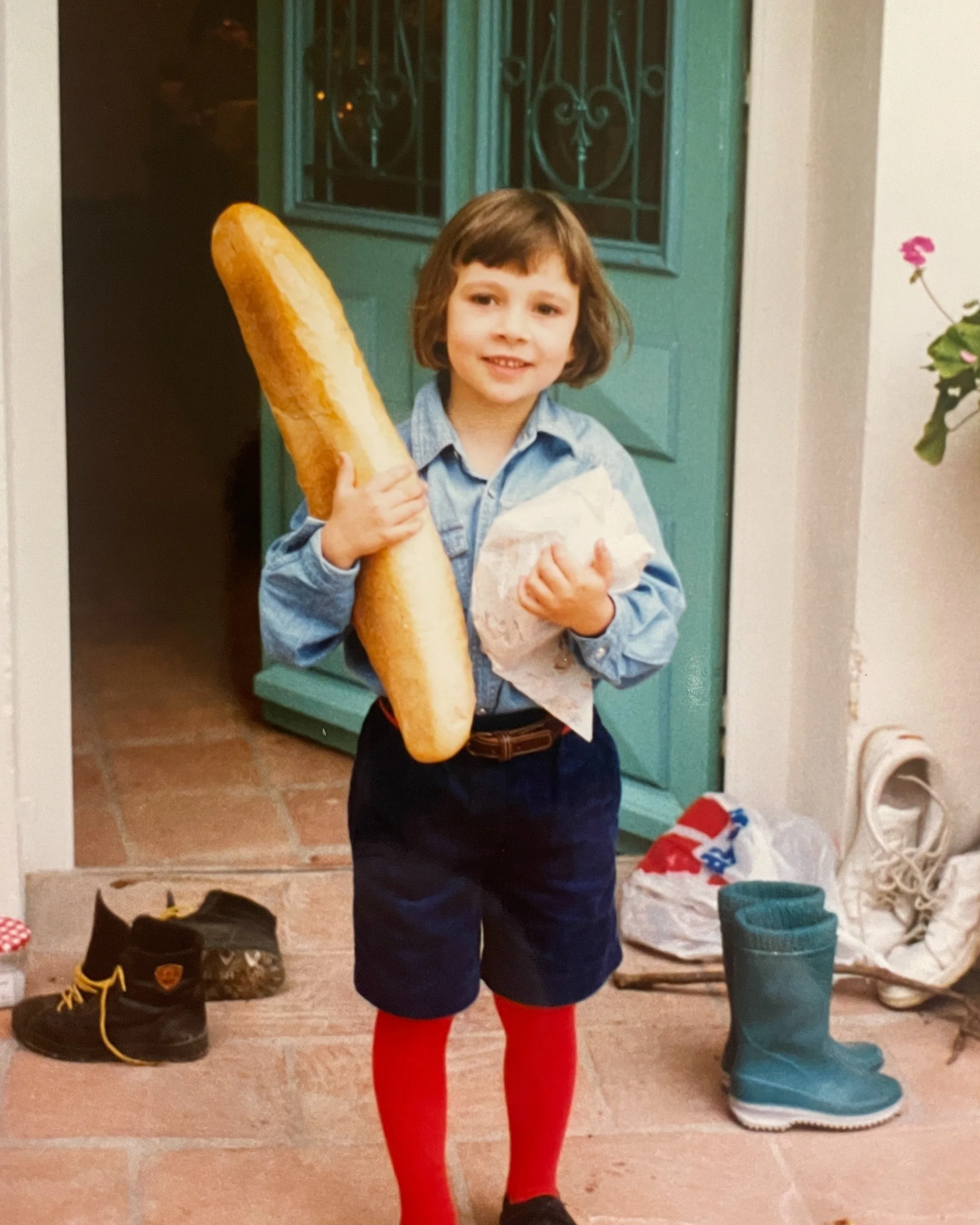
It is estimated that by the age of twelve, a child with ADHD will have received around 20,000 more negative or corrective comments than their neurotypical peers.
These aren't necessarily loud, huge criticisms. Most of the time, they are well-meaning reminders or nudges from teachers or parents who genuinely want to see a child succeed. But the sheer volume of these daily corrections leaves a mark.
When my preschool reports at age three said:"...her enthusiasm to finish and move on to the next page causes her to rush towards the end, thus making her work a little untidy."
And my reception report at age five noted:
"She needs to concentrate harder and I am sure she is capable of achieving much more."
The message was already clear: Your natural pace is wrong. You’re not focused enough.
By Year 2, when I was seven, the narrative was taking root:
"...she does tend to be rather too chatty and concerned with those around her."
"...can produce very good quality work when she concentrates."
"...must try not to interrupt others."
Even my parent feedback on that report read: “Hopefully her concentration and writing skills will improve as she matures (if she keeps quiet long enough!)”
Unconsciously (and sometimes very consciously) I was learning that my natural ways of connecting, processing, and navigating the world were things I needed to hide to be accepted.
The 2e Paradox
Because I was a 2e child, my school experience was a confusing mix of high academic achievement and quiet executive dysfunction. I was frequently praised as "bright," "mature," and "an able little girl with an enquiring mind". I could easily complete academic work with little effort, which shielded me from getting into ‘real’ trouble.
But the other side of the 2e coin was a stream of warnings that I was ‘wasting’ my potential:
"Emma must read through her work when it is completed and be realistic about her use of time." (Year 3)
"Emma needs to organise her thoughts and tackle work in a more systematic manner to reach her full potential... there is still a need to keep a check on tidiness..." (Year 4)
I learnt that even when I was trying my absolute hardest, my output wasn't matching the invisible standards expected of me.
The Apology of Self-Evaluation
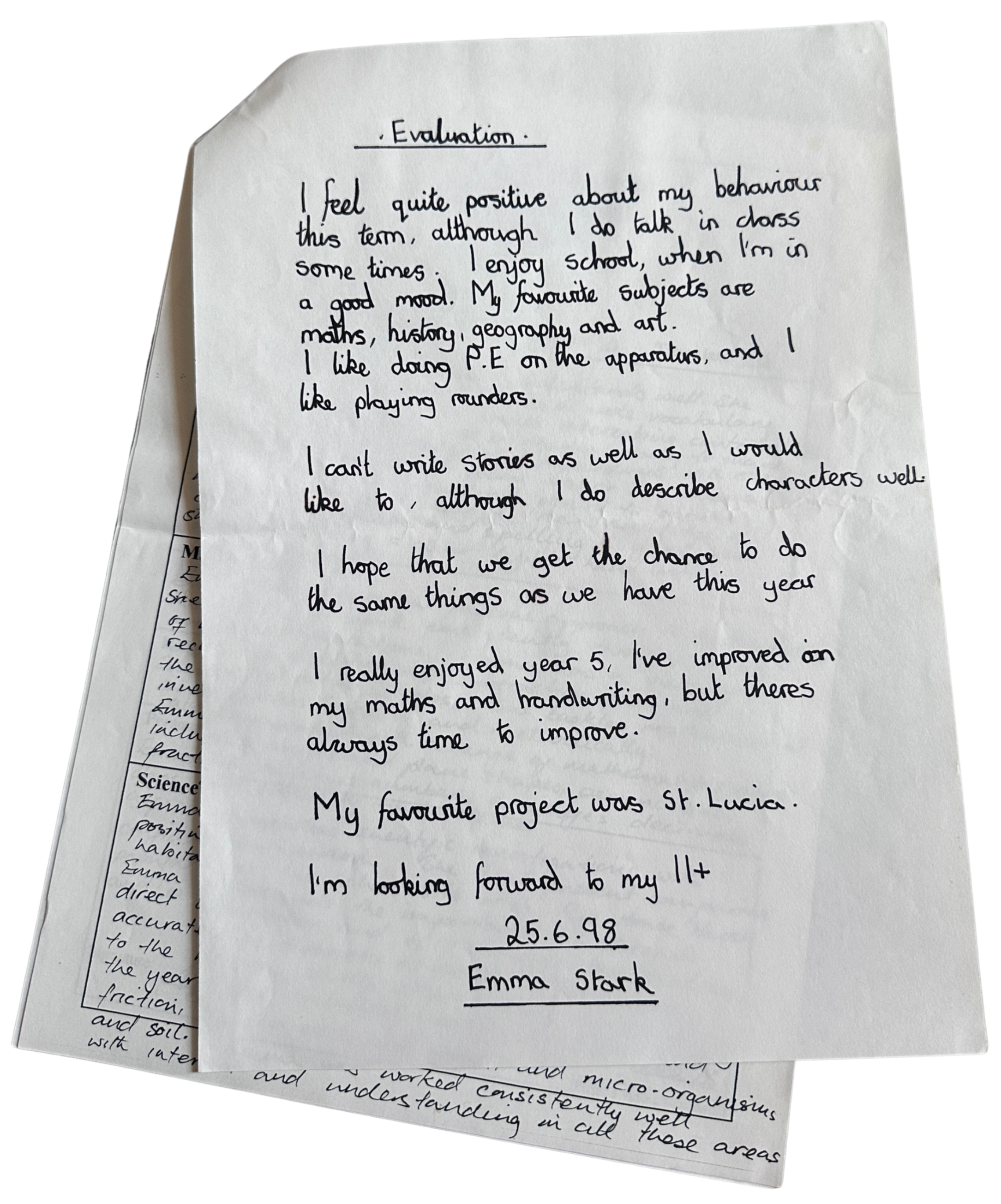
My school had us do self-evaluations at the end of each year that were sent home with our reports. Previous years I had mentioned needing to “improve my handwriting” or work harder in particular subjects but by Year 5, the internalised shame really began to show on the page. At nine years old, I was already incapable of celebrating my own progress without adding a disclaimer or an apology for my natural traits:
"I feel quite positive about my behaviour this term, although I do talk in class sometimes. I enjoy school, when I’m in a good mood. I can’t write stories as well as I would like to, although I do describe characters well. I really enjoyed year 5, I've improved on my maths and handwriting, but there’s always time to improve."
The Difference One Adult Makes (And Where the Messages Stuck)
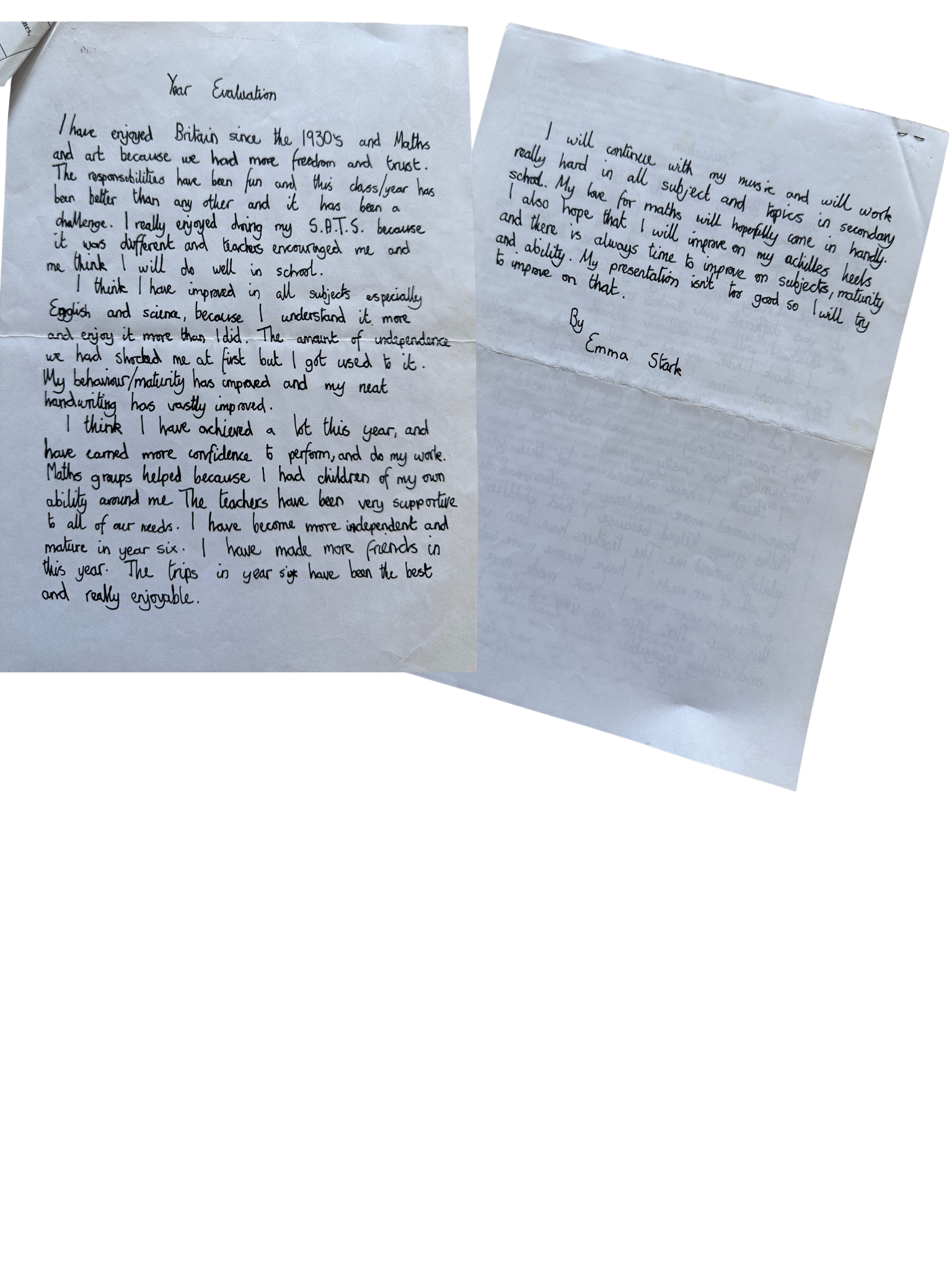
My primary school teachers were genuinely lovely, but my Year 6 teacher was different. He met my barriers with humour and focused heavily on my natural strengths. In that supportive environment, my self-evaluation transformed. I allowed myself to feel proud, confident, and capable:
"The responsibilities have been fun and this class/year has been better than any other and it has been a challenge. I really enjoyed doing my S.A.T.S because it was different and teachers encouraged me and I think I will do well in school My behaviour/maturity has improved and my neat handwriting has vastly improved.
I think I have achieved a lot this year, and earned more confidence to perform, and do my work. Maths groups helped because I had children of my own ability around me. The teachers have been very supportive to all of our needs. I have become more independent and mature in year six."
Reading these evaluations as an adult and parent of two primary school aged kids, it was encouraging to see the difference one validating adult can make to a child's self-worth.
But if you look at the very end of that exact same self-evaluation, you can see how deeply those early childhood messages had already become hardwired. Even in what was possibly my happiest, most encouraging school year, the pressure to ‘fix’ my brain was still running in the background:
"I will continue with my music and will work really hard in all subjects and topics in secondary school… I also hope that I will improve on my achilles heels and there is time to improve on subjects, maturity and ability. My presentation isn’t too good so I will try to improve on that."
At just eleven years old, even with an encouraging and genuine teacher, the old messages still held a firm grip. I was actively scanning myself for my "achilles heels," worrying about my "maturity," and viewing my messy presentation as a personal failure that I needed to work harder to ‘fix’.
A Moment of Perspective: On "Quiet" Struggles

I want to pause here to acknowledge something. When I look back at my school years, I am very aware that, relatively speaking, I was incredibly fortunate. My struggles were not as extreme as what many neurodivergent children experience. I wasn’t excluded from school. I didn't experience severe school trauma. Academically, because I was "bright," I was able to coast through much of the curriculum with very little effort. Primary school felt much easier and far more supportive. But everything changed when I transitioned to secondary school, where my struggles were compounded and magnified. Like many children in secondary school, I was bullied. To cope and find safety, I spent most of my break times and lunch times ‘hiding’ in the music department. I was surrounded by a small group of peers whom I considered my friends at the time, but looking back with adult hindsight, they were actually quite controlling.
I spent the majority of my teenage years minimising myself. I actively hid my intelligence to try and avoid being targeted as a ‘boffin’, whilst simultaneously trying to hide my executive functioning barriers so I didn’t get into trouble with my teachers or let my parents down.
Unsurprisingly, this constant masking and self-monitoring took its toll. I struggled deeply with low self-esteem and poor mental health, I developed unhealthy coping mechanisms which eventually led to me being in counselling from the age of sixteen. Yet, from the outside, no one saw the crisis. To the rest of the world, I was just a bright, slightly disorganised, and chatty teenager. But that is exactly the point…
This is why I feel so strongly about validating these struggles. A child's pain does not have to be loud, explosive, or lead to school exclusion to leave a lasting scar. The psychological toll of high-masking, of quiet isolation, and of constantly pushing your nervous system to exhaustion just to meet the expectations of others can be just as heavy to carry. Your experience (and your child's experience) does not have to be the most extreme version of suffering to be valid. Quiet distress is still distress.
The Adult Echo
Those beliefs did not stay in the school corridor. I carried them from secondary school into art school then university, and eventually my working and family life.
As a late-diagnosed adult, I still find myself fighting the belief that I am not living up to my potential. It is a conscious battle to remind myself that my ‘failures’ are not due to a lack of effort, that I should have tried harder at school, been less impulsive, careless or more motivated. It’s taken years, and a lot of therapy, to learn that I do not need to push myself to absolute exhaustion just to prove my worth.
Our children take these small, repetitive corrective comments on board more than we realise.
Shifting the Narrative: Everyday Advocacy
This is why I am so passionate about the work I do through Kind of Extraordinary. Supporting our neurodivergent children doesn't mean we sugar-coat their barriers or pretend that school isn't difficult.
It means we help them understand the whole picture. It means we protect their self-worth by ensuring their strengths are always highlighted, and their struggles are met with co-regulation and environmental support, rather than shaming them and setting ableist behavioural targets.
You can’t always shield your child from the pressures of a school system that was not designed to be inclusive. But you can be the safe person that helps them rewrite those early narratives.
You don't have to change your child to fit a rigid box… you just need to help the world understand how to support them.
Because you are already the expert in your child, and it is okay if you are both still learning 💜